
Open Letter To UNICEF

#BreakFreeFromFormula1

Dear Executive Director Russell, 

We are writing to you out of deep concern on the matter of UNICEF partnering with companies and franchises that are in opposition to the mission of UNICEF  and the promises you have made to us as children and youth, in all our diversity.

It recently came to our attention that UNICEF UK has formed a partnership with Formula One, an organization that over the years has distinguished itself for organizing races under the patronage of dictatorships (Azerbaijan, Bahrain and Saudi Arabia), which called the attention of civil society, including Amnesty International

In addition to human rights concerns, Formula One’s perpetuation of the fossil fuel industry, corruption, and intimidation has fueled the climate emergency we are facing now. In a single season alone F1 emits over 256,000 CO2 equivalent tonnes. Rather than ambitious leadership towards a just transition, F1 has greenwashed society with empty promises and illusions of care for the climate.  For example, their  Net Zero target by 2030 lacks commitments, actions, and accountability 1.  Recognizing UNICEF’s Children’s Climate Risk Index Report, that acknowledges the importance of treating “  climate change like the crisis it is and acting with the urgency required to ensure today’s children inherit a liveable planet.“, we are deeply concerned about this partnership. This misalignment of priorities forces us to reconsider our own collaborations with UNICEF. 

We are hence asking you to withdraw from this partnership with Formula One and stand with us in upholding the United Nations Convention On The Rights Of The Child, specifically:

ARTICLE 3 (the best interests of the child): In all decisions and actions that concern children, the best interests of the child shall be a primary consideration.

ARTICLE 12 (respect for children’s views): Every child has the right to express their view on matters that affect them, and for these views to be taken into consideration.

ARTICLE 24 (health and healthcare): ensure children have healthcare services, nutritious food, clean water, a clean environment and healthcare information.

“As UNICEF Youth Advocates, our mandate involves actively working with you on decision-making processes on important issues that affect us at national, local and global level. This is the time for you to hear us out and prioritize the people and the planet over profit.”-UNICEF Youth Advocate

We understand that managing such a large organization and its immense mandate is not easy and requires creative fundraising. At the same time, many of us work with and rely on UNICEF to help us survive  present climate risks and shocks as well as save our future from exponential climate change impacts. We believe UNICEF should walk the talk when it comes to committing to a better future for children, listening to children and young people, and doing its due diligence when selecting its partners and donors to ensure they reflect these shared priorities and join hands with us to champion the call for a global transition away from coal, oil, and gas. Therefore, we reiterate our call for UNICEF to dismantle its partnership with Formula One.

Thank you for your attention, we look forward to receiving your solidarity in ensuring a safe, secure, healthy and liveable planet for all of us. Remember, justice delayed is justice denied.  

In solidarity,

Global youth and children

Signed by (among others):

  1. FFF India
  2. FFF MAPA
  3. FFF SWANA
  4. FFF Digital
  5. There Is No Earth B
  6. New Hope For Poor
  7. Fossil Fuel Non Proliferation Treaty
  8. FFF Zambia
  9. FFF Sudan
  10. FFF Maghreb (+212)
  11. Save Future Bangladesh
  12. FFF- Sierraleone
  13. FFF – Kenya
  14. Viernes Por El Futuro Colombia
  15. FFF – GOMA
  16. Re Earth Initiative
  17. One Up Action
  18. XRY Liverpool
  19. FFF Kajiado
  20. YACAP
  21. FFF Morocco
  22. Klimastreik Schweiz
  23. Glasgow Against Arms and Fossil
  24. FFF Sweden
  25. FFF Indonesia
  26. FFF Togo
  27. FFF Czech Republic
  28. FFF Ukraine
  29. Greve Climática Estudiantil
  30. XR Biel/BIenne
  31. FFF IDJWI
  32. FFF Burundi
  33. FFF Windhoek
  34. FFF Zimbabwe
  35. FFF DRC
  36. FFF Scotland
  37. FFF Nigeria
  38. FFF Venezuela (central region)
  39. FFF Netherlands
  40. FFF AO
  41. FFF Germany
  42. XR Biel / Bienne Switzerland
  43. Youth For Climate Turkey

Europe Beyond burning

Europe Beyond Burning

We are in the middle of a climate and biodiversity crisis. We need systemic changes, but the European Union has instead offered us another scam. They have found a new remarkably scamful way to make them look “green”, by burning forest biomass for energy and classifying it as renewable in the Renewable Energy Directive (RED).

This is all being made worse as the EU classifies the burning of forest biomass as “zero emissions” in their targets, even though burning wood emits more CO2 per unit of energy than burning fossil fuels like coal or gas. Burning forest biomass is considered a renewable source of energy because ‘planted trees grow back’. However, forests are precious ecosystems, they cannot be re-planted. Also, these environmentally harmful planted trees do not grow back fast enough to meet the Paris agreement. 

Forest biomass must be taken out of RED. Join us in stopping this scam and demand REAL action and true renewables!

BIOMASS FOR ENERGY – FAKE CLIMATE SOLUTION

If forest biomass continues to be classified as renewable, countries will continue to burn biomass on an even larger scale in order to reach their renewable energy targets. This not only allows them to keep the old infrastructure and concept of “burning for energy” but also makes them look like “climate leaders” – but only paper.

Carbon from burning trees warms the climate; therefore, burning trees and other wood does not help, but instead it hinders the much-needed decarbonisation of the energy system.

We cannot solve the climate & biodiversity crisis with the same mindset that got us into it. We must uproot this system!

 EU POLICIES ARE DESTRUCTION-AS-USUAL

The problem is real and urgent. Burning forest biomass is heavily subsidised by EU taxpayers’ money. We have already paid out approximately €10 billion a year, meaning that all of us are unknowingly paying for burning, instead of funding truly renewable energy sources. This absurdity must be stopped now. The EU must take forest biomass out of RED – and we will fight for it!

What you can do

Organise with us:

Join the Campaign!

Join the group FFF: Europe Beyond Burning and the channel Europe Beyond Burning Channel – via there you can stay updated on the campaign and join the calls

Video

Share the video with the call to action by Greta Thunberg to Frans Timmermanns from the EU Commission.

Campaign Toolkit

Share the campaign toolkit with your country’s FFF chapter!

Sigh the petition to #StopFakeRenewables

Join the digital and physical actions!

  • Physical: Organize actions on the International Bioenergy Day (21st October), calling the EU to take forest biomass out of RED
  • Digital: Participate on the Tweet and social media storm (more infos with digital campaign wg); Write your own open letter in national media; Post and speak up online using the official hashtags: #EuropeBeyondBurning #StopFakeRenewables

Find us on social media

Supported by

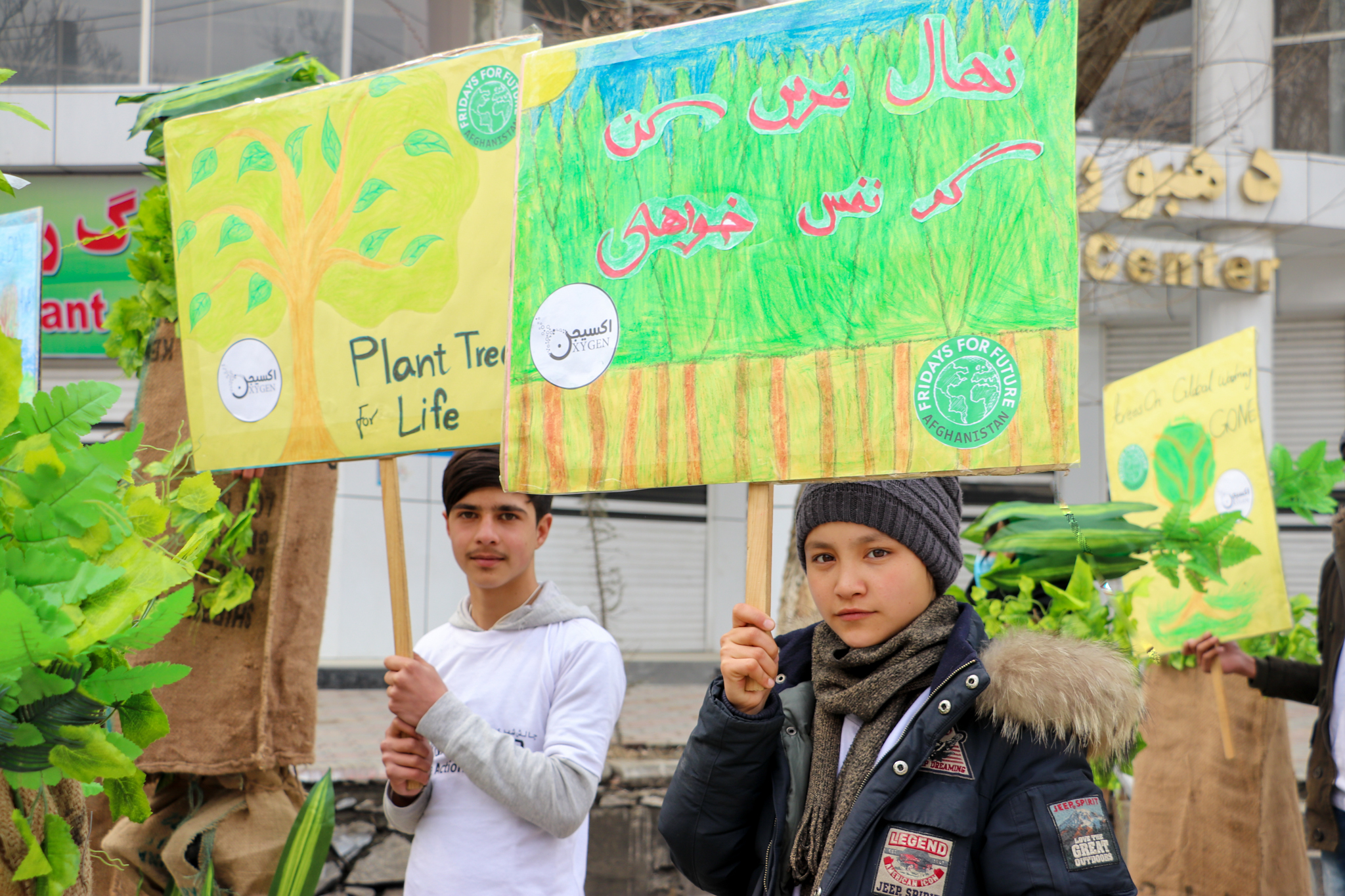
Afghanistan

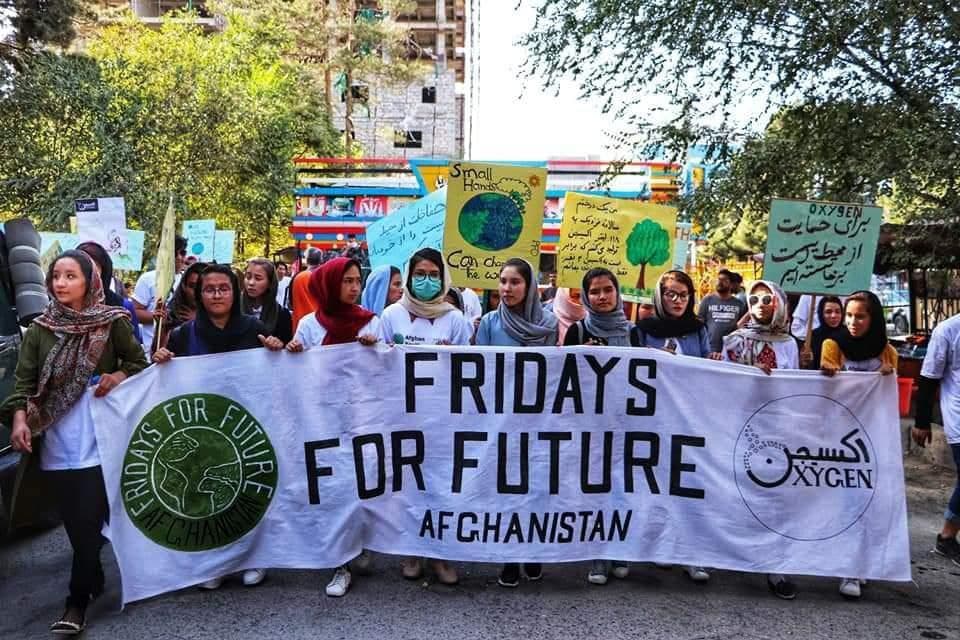
Climate activists have become targets in Afghanistan


Their tireless work to create a sustainable future has put them and their families gravely at risk. They urgently need to escape the country, or risk being killed by the Taliban.

We are the Activists in Risk Zones (ARZ) Task Force within Fridays For Future. Ever since the Taliban took over Afghanistan, we FFF activists all around the world in collaboration with NGOs and organisations have been working extremely hard to get high at risk activists and their families out of Afghanistan.

Our rapid response team is in contact with our youth members on the ground and are working with state officials, trusted NGO partners and supporters to get people to safety. In only a few weeks time we were able to safely evacuate 39 people from Afghanistan to Pakistan, Germany and the US etc.

We have set up this crowdfunder to raise urgent funds to get more high at risk people and their families out of the country to countries where they can safely resettle and start a new life.


Your donations will pay for flights/transportation, visa fees, support, legal fees, and any other costs incurred with getting people to safety and it will also help cover resettlement costs for our evacuees.
Please donate and share with anyone and everyone. Activists need your help to save lives. Every small amount helps!


Thank you for standing with us.
Donate Now!
We ask you to support our efforts! Any donation is appreciated.

NOTE:
All funds raised for this campaign are hosted by Climate 2025, a not-for-profit that supports movements tackling the climate and ecological emergency.

For larger donations and all external enquiries please contact us.

If you are part of an NGO or state department that we’re not yet connected to, and you have relevant information that might assist our rapid response team, please get in touch there.

Thank you!

No More Empty Summits

No More Empty Summits

On April 23, we are doing different actions in time for Earth Day and the Leaders Summit on Climate!

Cut the Bullshit

Our Demands:

1. End fossil fuel investments and subsidies immediately

2. Stop the plunder of the environment especially in the Global South which are the most affected areas

3. Have annual, binding carbon budgets that factor in justice and equity, concrete plans, roadmaps, and milestones to get to actual net zero.

Our Letter:

To our world leaders today,

On April 22nd and 23rd, US President Joe Biden invited 40 heads of state to the Leaders Summit on Climate, but what have you so-called leaders done? Definitely not enough. It’s mostly the same “leaders” that have been spewing out empty promises. You have ambitious themes for your summit, but we’re sick of talk. We need action. Cut the bullshit.

We are running out of time, yet all you’re doing is holding summits to feel important and congratulate yourselves. For what? For all your far-off net zero targets or your new “amazing plans” for your near-term targets that are still heavily insufficient and full of loopholes. But just like in the children’s story “The Emperor’s New Clothes,” you are all just fooling yourselves and each other with your “magnificent clothes.” read more


What is the Leaders Summit on Climate or the Biden Summit?

When he took office in January 2021, President Biden announced that he would be holding a summit for 40 World Leaders to discuss global action on the climate crisis on April 22nd and 23rd. The supposed aim of the summit is to galvanise global efforts of staying below 1.5 degrees Celsius of warming and to be “a key milestone on the road to the United Nations Climate Change Conference (COP26)”. Yet rather than opening the summit to all – and especially those in MAPA (Most Affected Peoples and Areas or Global South), President Biden has instead invited only 40 heads of state – including many who have already proven that they do not care about the climate crisis and in some cases denying that we are currently living through it. 

For climate to be addressed in a just and equitable manner, historically underrepresented communities must be present in these conversations. Excluding the voices of nations in the Global South, those facing the brunt of climate impacts created by the Global North, limits intersectional and equitable action and lessens the global responsibility of the Global North to address its disproportionate impact.


Why is FFF protesting

The Leaders Summit on Climate invited only 40 heads of state, and is going to be mostly the same “leaders” that have been spewing out empty promises. We don’t have time for this — so we’re saying end the bullshit. True leadership is found with the people, especially those at the frontlines of the climate crisis. The decisions needed to achieve climate justice will be made not because of the long-winded conversations of these “leaders,” but because of the people uniting together in every way we can, on the streets and online. Let’s show everyone what true leadership is like!
A new system can’t be built by the same elite colonizers who are leading our current destruction. Inequality is at the heart of the climate crisis. We need to amplify the voices of MAPA (Most Affected Peoples and Areas) to make sure that the past systematic problems won’t be repeated. No more empty promises! No more empty summits!


Toolkits

Physical actions

In small groups of people, hold a speech of what our country’s Head of State should be saying at the Biden Summit (whether or not they were invited).

Send us a picture and video of your action so we can combine our voices and show our strength.

If you want to hold a physical action, here’s a toolkit with step by step instructions!
Here is a press release template along with different quotes from MAPA that you can use.


Mock SUmmit

On April 23rd, we held a digital version of the Physical Actions from above. We protested against Bidens Summit by holding our own little Mock Summit, speaking the truth that the Heads of State at the Biden Summit aren’t saying and raising the voices of those that should have been heard at the Biden Summit. Watch it below!


Clean Up Standard Chartered

Clean up Standard Chartered

Fridays for Future fights against Standard Chartered Bank’s abuse of environmental and human rights by providing finance to fossil fuel expansion. As a movement, FFF rises up to stop SCB from financing fossil fuel companies immediately.

What is this about?

Divestment Campaigns:

A key driver of the climate crisis is the global financial system which continues to invest, lend and direct capital flows to new fossil fuel exploration and infrastructure. As 1.2°C of global warming is already the hell for most countries, it is time to end this dirty business. Fridays for Future make sure of that. 


Who is SCB?

Standard Chartered is the UK’s coal bank, a climate killer. This bank is investing billions in fossil fuel companies all over the world. In total, with their dirty business they have channelled $24 billion into coal, oil and gas companies already since the Paris Agreement.

Why SCB?

The SCB is one of the world’s largest coal financers, with significant fossil financing particularly in MAPA and regarded as a critical first-mover on the global financial market. With COP26 being in the UK this year and SCB being headquartered in the UK, this is a perfect opportunity to remind them to raise their standards. With $8.5 billion this bank is one of the largest financiers of coal expansionists since the Paris Agreement. Mainly, the investment goes into coal plants, mines, and infrastructures developers in Asia and Africa, like Indonesia and the Philippines.

Some of the companies that SCB finances and are active in Indonesia are PLN Persero, Indonesia Asahan Aluminium , Adaro Energy.  In the Philippines they finance other companies like  Top Frontier Investment Holdings, Aboitiz Equity Ventures and Marubeni Corporation. They even finance a company active in Argentina called AES. The world’s most aggressive coal plants expansionists. They also finance the coal mining companies Glencore and Anglo American.

The companies are headquartered in Switzerland and the UK, however their business lies mainly in South Africa, Colombia and Australia. SCB also finances the Canadian company First Quantum Minerals which is currently constructing a coal power plant in Botswana. Despite almost half of the population not having access to reliable electricity, the power would be exported to South Africa. In South Africa, they finance Eskom which is operating incredibly dirty coal plants and still has massive expansion plans.

What can I do?

Organise with us:

Physical Actions:

  • Physical action signs, stickers, banner designs, letter template for standard chartered bank office, etc, are available here.
  • Organize actions targeting SCB as one of your targets for the Global Climate Strike on March 19th #NoMoreEmptyPromises.
    • This can be in front of SCB offices.
    • It can also be in public places where people will see even if there’s no SCB office in your country.

There are different levels of engagement for youth climate activists/ groups. It does not matter what level you choose please make sure you take as many pictures as possible and upload them here.

If you can do any level of these actions please join the channel.

Level 1. Print /paint the campaign logo and have at least one in your strike (even if the strike is about other things too)


Level 2. Do some stickering / poster sticking in front /near your SCB office; if there’s no office in your city, use the stickers template talking about general bank divestment (getting banks to stop funding coal)


Level 3. Strike anywhere in your city about SCB, make sure to have the campaign logo in your signs (difference with level 1 is for level 3, SCB is one of the main focuses of your strike)


Level 4. Print/draw the campaign logo and other SCB related signs in your strike and have a strike in front of the SCB office (alone or with others)

Digital Actions:

  • Our official hashtags: #CleanUpStandardChartered & #RaiseYourStandards
  • Participate on the Tweet and social media storm.
  • Write your own open letter in national media.
  • Check out the toolkit.

Share pics:

All ready to go!.

Sample captions:

Standard Chartered Bank is fuelling the climate crisis 🔥 While they pretend to be decarbonising in their greenwashing advertisements, they are investing billions in fossil fuel projects all around the world. Since the Paris Agreement, they have channelled $24 billion into coal, oil and gas companies #CleanUpStandardChartered #RaiseYourStandards

@stanchart pretends to be committed with sustainability, yet it is the world’s largest coal financer since the Paris Agreement. We won’t accept #NoMoreEmptyPromises. It is time to end their dirty business. Join us to demand #CleanUpStandardChartered ‼️and keep an eye on ➡️ www.FridaysForFuture.org/CleanUpStandardChartered

Tweets:

(Notice: use at your own risk.)

Supported by:

FFF Argentina
FFF Latin America
FFF Digital
UKSCN Wales
Climate Strike Canada
FFF México
Jeda
FFF Germany
EA Turkey

FFF Philippines
YACAP
FFF Scotland
FFF Bangladesh
JOCA
FFF Kenya
FFF Brazil
FFF Zambia
YFC Turkey

FFF Italia
FFF Colombia
FFF Windhoek
FFF Zimbabwe

News

Want updates from FFF? Subscribe to our newsletter!

Contact

For topics related to campaign only. To contact FFF please see this page.

#TheWorldIsWatching

A year ago, the world’s most powerful people gathered in Davos. The World Economic Forum’s annual meeting was, as always, about business and politics, but climate was given more importance than ever before. The consequences of this were hard to see – action should have followed but far too little happened this year.

It was not an easy year, in many ways a foretaste of things to come. It was one of the hottest years on record and its disasters destroyed and took the homes and lives of hundreds of thousands. To make it through this unusual year, it was necessary to show global solidarity. However, this cannot stop with the pandemic. Especially in order to slow down human-caused global warming, this solidarity is absolutely crucial. Only if we all pull together, all pursue the same goal, all stand up for a future worth living, we can make a difference. 

With the publication of the Davos Agenda 2021, the WEF aims to deliver solutions to 7 key areas – climate change being one of them. As a key player in international cooperation, the WEF and its members have an enormous responsibility towards the entire world population.



The global players can no longer hide behind empty words and greenwashed solutions. They must act according to their responsibilities and know that the world is watching each and every of their moves.

On Friday the 29th of January we will make the WEF and it’s members aware of their responsibility. With the hashtag #TheWorldIsWatching, we show that they must act accordingly and that the time for excuses is over.

At 10am UTC, a tweetstorm will take place under #TheWorldIsWatching.

We are also calling for a Digital Strike. Make a sign, take a picture with it and post it on social media with the hashtag #TheWorldIsWatching. If the situation in your country allows it, we emphasise having a physical strike.

Power to the People – see you on Friday!


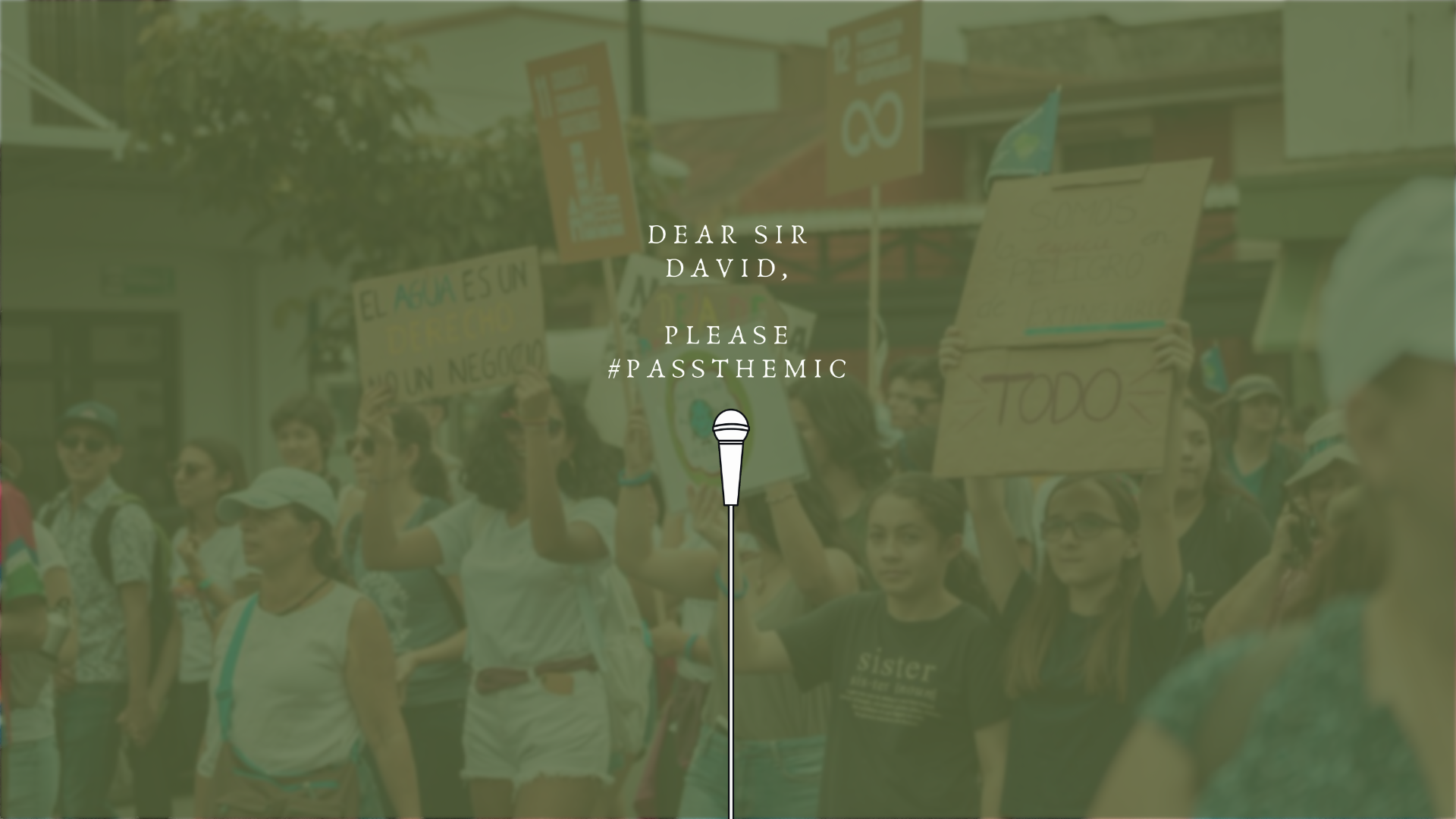
Pass the mic Sir David

Dear Sir David Attenborough and team,

Your work has inspired millions; many celebrate and advocate for Planet Earth and its inhabitants because of you, and the legacy you will leave behind is comparable to almost no one. You have raised awareness about a world which currently hangs so deftly in the balance between two paths, and whose unpredictable future is now in the hands of a younger generation.

But the legacy you leave is not yours alone. The platform you have created on Instagram has shown the power of your influence, yet Earth’s true fate has lain in the hands of frontline defenders for centuries. This is why we are asking you to pass the mic: to hand over your Instagram account, and therefore audience, to those who have been campaigning for the natural world like their lives depend on it, which in many cases it indeed does.

Many were disheartened by the news that you and your team have decided to retire your Instagram account, despite garnering a monumental audience in an incredibly short time, and reaching people that perhaps would never have considered the importance of rapid climate action otherwise.

Social media is a powerful tool for change and mobilisation; a platform for so many who do not have the luxury of privilege to amplify their own voices as and when they desire. For so many Indigenous People and People of Colour, social media is an outlet to share struggles, raise awareness about threats, and connect with others who share the same messages of hope and change. With six million people at your fingertips, the power to shift the narrative of the climate crisis is a reality – from one that focuses on the decades ahead, to one that shows the reality of climate change to the world’s most vulnerable today.

By agreeing to pass the mic, you will help create a culture of community; a collective, where those with the power to change things open their eyes to the struggles of those without power. It creates a narrative in which vulnerable people have their stories heard, and facilitates the imperative dialogue that’s needed between the Global North and South around the role of the responsible and the plight of the victims. Indigneous Peoples and People of Colour have had their voices silenced for too long.

Your own statement: “humankind has overrun the plant” implores us to ask, “Who is ‘humankind’?”. Passing the mic will enable climate change to be tackled from the inside out – to exhibit the role of neo-colonialism and capitalism in warming the planet. Shifting the conversation to lay bare the root causes of climate change will achieve climate and social justice for all. We hope you are willing to get behind this new discourse.

As 2020 comes to a close, there is a great sense of fear and uncertainty ahead. This year alone has shown us that uncertainty plagues our future, and we aren’t necessarily well-equipped to adapt as fast as we think we can.

We truly believe you feel a sense of duty to advocate for those frontline communities who have done so much to defend our planet, and we implore you to ask yourself: what use is power and influence if not to advocate for the world’s most vulnerable?

The survival of this planet depends on all of us as a collective. Today we see the strength of global unity in the fight against climate injustice. We have to unite if we are to make a real change.

Instead of allowing your Instagram account to lay dormant we, and the supporters/sign notarize  below, implore you to hand it over to youth activists, environmentalists, conservationists and frontline communities to mobilise the audience in the ways outlined in this letter.

#PassTheMic


Total number of signatures: 243
Latest signatures:
  • Janine Powell, London, United Kingdom
  • Mitzi Jonelle Tan, Manila, Philippines, Youth Advocates for Climate Action Philippines, Fridays for Future
  • Erika Lizette Portillo, Los Angeles, California
  • Viviana Tapia González, Aguascalientes, México
  • Sarah Hoban, Ireland.
  • Dhaanya Ganeriwal, My Green Mantra - Hong Kong
  • Stoness Verda, Toronto Canada
  • Loralee Michelle, Aurora, ON Canada
  • Tori Tsui, Hong Kong/United Kingdom
  • Joycelyn Longdon, United Kingdom, ClimateInColour
  • Anushka Bhaskar, United States, Avritah + Intersectional Envrionmentalist
  • Emma Mamisoa Nomena, Madagascar
  • Helena Bennett, United Kingdom
  • Isabella Futcher, Australia
  • Tara Louise Roberts, United Kingdom
  • Symke Nieboer, The Netherlands
  • Nicole Becker, Argentina
  • Theresa Rose Sebastian, India/Ireland
  • Celina Chien, UK/Canada/Netherlands
  • Ariane Desrosiers, Hong Kong/USA, Asian Environmental Youth Network
  • Mara de Pater, the Netherlands
  • Lina Gobbelé, Germany
  • Dominique Palmer, United Kingdom. Fridays for Future
  • Alexandra Buck, Germany, Fridays For Future, SOS Amazonia campaign FFF International
  • Eyal Weintraub, Argentina, Jóvenes por el Clima, Fridays For Future International
  • Lauren Wotherspoon. Toronto, Canada
  • Hema Reddy, Australia
  • Elizabeth Teo, Canada
  • Chelsea Webster, Vancouver, Canada
  • Mackenzie Cumming, Canada, Fridays for Future Calgary, Climate Strike Canada
  • Ismael Canizalez, California, United States of America
  • Rebecca Muzek, Australia
  • Brittany Cattaruzza, New York, United States of America
  • Sofia Voudouroglou, The Sustainable Fashion Guru, Greece/United Kingdom
  • Carrie L. Hale, United States of America
  • Federica Cardamone, United States of America
  • Aoife Bruen, Australia/UK
  • Agnes Imgart, Germany, Parents For Future Global
  • Rebecca Hainsworth, United Kingdom
  • Ashley Du, United States of America
  • Yolanda Waters, Australia/China
  • Emma Dinning Canada
  • Becca Payling, UK/Ireland
  • Paigan Fletcher, New Zealand
  • Saskia Bhageerutty, Uk
  • Catalina Hildebrand, The Netherlands
  • Pelle Berting, The Netherlands
  • George Steedman Jones, United Kingdom
  • Kevin J. Patel, United States of America, OneUpAction International
  • Micaela Collins, Canada/ United Kingdom
  • Melenn Herve, United States of America, Orange County Environmental Justice
  • Sarvi Kasiri, Canada/Iran
  • Taiyba Ali, United Kingdom
  • Sarah Day, Canada/Vietnam, University of British Columbia
  • Emily Victoria, United Kingdom
  • Sofía Hernández, Costa Rica, Fridays For Future Costa Rica
  • Disha A Ravi, Fridays For Future India
  • Ella Daish, United Kingdom
  • Helen Coleman, United Kingdom
  • Matthew Jarvis, United Kingdom
  • Azul Schvartzman, Eco House, Argentina
  • Jada Kennedy, Belgium, Youth for Climate Belgium
  • Rachel Heckerman, United States of America
  • Taylor Boisclair, Canada
  • Rebecca Hughes, United Kingdom
  • Ling Tin, Canada
  • Ariane Wrumnig, Austria, Youth Wilderness Ambassadors
  • Ines Vilhena, Portugal, climate activist
  • Roxana Borda, Perú
  • Lena Gerstmans, The Netherlands
  • Meg Watts, United Kingdom, University of East Anglia Sustainability Society
  • Juanjo Martinb, Chile, Cverde NGO
  • Valentina Prada Flórez, Colombia, Fridays for Future Bogotá, Latinas for Climate
  • Karin Watson Ferrer, Chile, Amnesty International & Re-Earth Initiative
  • Jocelyn Gee, United States of America
  • Sophie Boardman, United States of America
  • Meg Lazaros, United States of America
  • Sara Freitas, Brazil
  • Catalina Santelices, Chile, Fridays For Future Chile & Latinas For Climate
  • Emily Mall, United States of America
  • Eugenia Chow, Hong Kong, Bye Bye Plastic Bags HK
  • Philip Aiken , U.S.A, Intersectional Environmentalist
  • Kiana Kazemi, U.S.A, The Leaflet
  • Gundula Wagner,Namibia
  • Michaela Peters, Ireland and Canada
  • Lottie Bingham, United Kingdom.
  • Kisjonah Roos, The Netherlands
  • Ina-Maria Shikongo, Namibia, Friday’s for Future
  • Lara Rudar, United Arab Emirates, Emirates Nature-WWF
  • Jessica Kleczka-Peverell, Wales, United Kingdom
  • Prerana Gurung, United Kingdom
  • Soma Jem Sundhu, United Kingdom
  • Collette Levy-Brown, Botswana/ Zimbabwe
  • Kimberly Moens, Ms Universe Elite 2019/2020, Netherlands
  • Rachel Boyett, United Kingdom
  • Elinor Spencer, Scotland, Xr Scotland
  • Jorge Sánchez Hernández, Spain
  • Morgane Le Sech, France
  • Jacqueline Wallace, United Kingdom, End the Virus of Racism
  • Amber Wyard, Wales, United Kingdom
  • Adam O'Hare, Birmingham, United Kingdom, Europe, The World
  • Veruschka Dumeni, Namibia, Fridays For Future Windhoek.
  • Nicola Todhunter, Newcastle, United Kingdom
  • Ella Van Cleave, British Columbia, Canada
  • Leia Achampong, London, United Kingdom
  • Sofia Ferreira, Oslo, Norway
  • Shen Nanyanga, Namibia, Eden Namibia
  • Lukas Kiefer, Germany
  • Karam Nwilati, Germany
  • Sanjeev Kumar, Founder, Change Partnership. Belgium.
  • Alexandre Muller, Brazil
  • Samantha Povey, United Kingdom
  • Ashlee Barnes, UK
  • Emily Sanders, UK
  • Denise Donaldson UK
  • Hana De Pauw, Brussels, Belgium
  • Nikki Dekker, PECT, UK
  • Delfina Chenevier, Fridays For Future Argentina
  • Sophia Morad (Fridays for Future Germany)
  • Anahí Canton, Fridays For Future Argentina.
  • Ayia Lindquist, Taking Nature Black, United States/Virgin Islands
  • Kristy Drutman, USA, Brown Girl Green
  • Zahran Sofi, UK, Talking Circle London
  • Zaqiya Cajee, London, UK
  • Katarina Slovakova, Slovakia, initiative Students with no name
  • Maria Lee, Greenpeace, UK
  • Ria Patel, UK
  • Simona Hlavacova, Slovakia, Circular Hub
  • Nupur Nagar, India/Spain
  • Megan Unger, Canada
  • Hayley Rose Dean, England, U.K
  • Kate Gard Cooke, England U K
  • António Pedro Dinis & Angie Zach, Austria
  • Laura Verónica Muñoz, FFF Colombia, Bogotá
  • Holly Rose, England / ‘Canada’
  • Jaylene Mbararia, UK
  • Joelle Phua, London, UK
  • Stephen Kent, UK
  • Sara Arnold, UK, Fashion Act Now
  • Sarah Marshall, UK
  • Lauren Ritchie, The Bahamas
  • Sofía Gutiérrez, Colombia
  • Tolmeia Gregory, Cheltenham, UK
  • Dora Botta, London, UK
  • Talia Woodin, London, UK
  • Frances Fox, UK
  • Jessie Nicholls, England, Fridays For Future
  • Josephine Becker, Edinburgh, UK
  • Elie Gordon, United Kingdom
  • Cass Hebron, Belgium
  • Rodrigo Garro, México
  • María Fernanda Moya, Chile, EcoVerde
  • Francisco Reyes, Chile, Extinction Rebellion Youth
  • Zoe Keller, United States (artist)
  • Saoi O’Connor, Ireland, Fridays for Future
  • Marcos Royo Asensio, Spain, Juventud por el Clima/Fridays For Future Spain
  • Georgia Allen, Northern Ireland, Youth Climate Association NI/Fridays for future
  • Zara Breen, Northern Ireland, Youth Climate Association NI/Fridays for future
  • Katie White, UK
  • Caroline Ortmann, Germany, previously organizer for “Fridays for Future” in Bayreuth
  • Laura Lee, UK
  • Nicole Ng, UK
  • Gunjan Menon, India, Conservation Filmmaker
  • Vivien Wiener, Hungary
  • Danielle Sams, UK
  • Anna Shaw, UK
  • Bethany Webster, U.K.
  • Alexandra Ranft, UK
  • Michelle MacRae, UK
  • Ahmad Mujtaba Raja, UK
  • Rose Scanlon-Jones, London, UK - Ecologi
  • Dane Trampas Avery, London, UK - Sunset+Vine
  • Orsolya Becsey, Budapest, Hungary
  • Emily Mason, Ireland
  • Meagan Holdeman, USA
  • Alexandra Lastouillat, France
  • Giulia Costa, Geneva, Switzerland
  • Mikaela Loach, Edinburgh, UK
  • Frances Haddock, UK, Extinction Rebellion Sheffield
  • Julia Gentner, USA
  • Emiliana Rickenmann, fff Colombia- climate strike switzerland
  • Anouki Heß, Germany
  • Kate Newman, Australia
  • Emma Lancaster, UK
  • Eliana Bernat, United States
  • Sarah Hill, USA
  • Martha Shepherd, UK
  • Sanita Tailor, UK
  • O’Niel Leadon, The Bahamas, Sail For Climate Action/Building Bridges For Climate Action
  • Bronwyn Raper, UK
  • Lukas Schwab, Fridays for Future Germany
  • Ianthe Minnaert, the Netherlands
  • Teanna Zwicker, Canada
  • Orla McLelland, London, UK
  • James Poston, UK
  • David Morales Rodriguez, Spain
  • Sarah Peterson, Virginia, USA
  • Dom Jaramillo, Costa Rica
  • Génesis Valenciano, Costa Rica
  • Erol Villacorta, The Philippines
  • Raeeka Yassaie, United Kingdom
  • Bryony Homewood, United Kingdom
  • Virginie Mascaro, United Kingdom
  • Laura Young, Glasgow, Scotland
  • Carmen Sinclair, London, United Kingdom
  • Esther Akatwijuka, UK, XR Youth Bristol, Bristol Youth Stri
  • Danielle Andrews, Geneva, Switzerland
  • Hester Watson, United Kingdom
  • Ella Wooden, UK
  • Evie Rouxel, UK
  • Tasvi Shah, UK
  • Roisin McGrory, Edinburgh, UK
  • Freya Tischkowitz, United Kingdom
  • James Gigg, United Kingdom
  • Adele Lister, UK
  • Skye Hollywood, UK
  • Nehal Doshi, UK
  • Kushal Malde, UK
  • Rahul Bagai, UK
  • Frances Osborne, U.K.
  • Melissa Watt, UK
  • Tejal Doshi, UK
  • Bronwen Adlington, UK
  • Faith Harris, US
  • Jacinta Hamley, Ireland
  • Emilie Portås Anderssen, Norway
  • Flora Beverley, UK
  • Violet Beverley, UK
  • Sadie Levi, UK
  • Dr Fiann Smithwick, UK
  • Tanja Rakocevic, Germany
  • Abdourahamane Ly, Guinea
  • Lily Scott, UK
  • Isabella Presnal, Finland
  • Sharon Adetoro, UK
  • Lillia Adetoro, UK
  • Muireann Carey, Ireland
  • Kaossara Sani, Togo
  • Lisa Mulder, the Netherlands
  • Callista Pitman, Canada
  • Hollie Taylor, UK
  • Linsy Eldridge, Ontario, Canada
  • Alexandra Blakeney, Canada
  • Laura Lock UK
  • Daniel Coughlan, Cork, Ireland
  • Brittney Brown, Canada
  • Hayley Butler, United Kingdom
  • Daniela Larios, Honduras
  • Tiana Crouch, Australia
  • Tiiu Olsen-Crouch, Australia
  • Pippa Ashcroft, Wales, UK
  • Reza Cristian, SUSTAIN the MAG (US)
  • Alice Clements, United Kingdom
  • Dorottya Sipos, Hungary
  • Lauren Manson, United Kingdom
  • Orla Duffey, United Kingdom
  • Kathryn Paisey, UK
  • Anastasia O’Shea, Ireland
  • Madeleine Johnson, United Kingdom

Sign the open letter!

  • By signing the letter, you agree to the following:

    • That you stand behind the purpose of the letter.
    • That your name or nickname and country are published on the website (fridaysforfuture.org).
    • That we store and handle the attached personal data until the campaign has ended, and an additional three (3) months thereafter (maximum 1 year).

    For more information, please read our Terms & Privacy Policy


By:

  1. YACAP (Philippines)
  2. FFF Costa Rica
  3. FFF Colombia
  4. UKSCN (England & Wales)
  5. FFF Brazil
  6. AYICCZim (Zimbabwe)
  7. JOCA (Argentina)
  8. FFF India
  9. FFF Namibia

SEPTEMBER 25 – GLOBAL DAY OF CLIMATE ACTION

THANK YOU!

We live in the midst of a pandemic, but climate change is just as much of a crisis as it was before.
We called for a Global Day of Climate Action on September 25th, and more than 3,500 towns and cities in 154 countries followed!

  1. Press release
  2. Support MAPA
  3. Social Media

PRess release

Click to view full press release

This fall, school strike movement Fridays For Future calls for a global climate action day. On September 25th, demonstrations and manifestations will take place all across the globe, all adjusted according to Covid-19 circumstances.

During the last few months, the Covid-19 pandemic has forced activists to find new ways of protest and use digital activism to demand climate action, as marches have not been appropriate. The 25th of September will be the first global action day of the year.

The coming months and years will be crucial in ensuring a safe pathway below 1.5°C increase in global mean temperature, a target stated in the Paris Agreement. If we are to minimise the risks of triggering irreversible chain reactions beyond human control, we need to act now. It is therefore vital that the climate crisis doesn’t get forgotten in the shadow of the coronavirus but is regarded as the utmost priority. Fridays For Future will keep protesting as long as exploitation of nature is allowed to continue. The form of protest will be adjusted according to local Covid-19 conditions and in places where physical action will be taking place, participants will be asked to take precautions to prevent the spread of the virus. In cases where physical protest is inappropriate, we will instead turn to digital action.

“The pandemic has shown us that politicians have the power to act quickly and consistent with the best available science. But not even amid a pandemic is the climate crisis on hold. No measures have been taken to lower worldwide greenhouse gas emissions in a sustainable and just manner. The billion-dollar-investments that are now made to tackle the pandemic and its aftermath must be in line with the Paris Agreement”, says Eric Damien from Fridays For Future Kenya.

“To actually experience the climate crisis makes you understand the urgency of the situation. Millions are losing their homes and livelihoods, this can no longer exist in a vacuum. We need world leaders to prioritise humanity over greed. The youth are going to come together, over and over again – each time more strategic and united than ever before”, says Disha Ravi from Fridays For Future India.

We will keep you informed about the details concerning the planning of the protests.

Due to the current circumstances actions may vary from normal, because in times of crisis we change our behaviour. Please contact or follow the directives given by your local organisers.

Ways to continue to support MAPA (Global South)

MAPA or Most Affected People and Areas, a term we’re using complementary to Global South

On September 25, we asked you all to have a moment during your strikes to do the MAPA symbol (found at the top & to the right) while someone is talking about the situation in MAPA (key facts can be found in the resources folder in the MAPA folder linked above) and we got so many great actions – thank you!

Please continue to support MAPA:

  • Say the tagline for MAPA (for international) “They are unheard but not voiceless. They are fighting for their present, not just their future. We will not be prisoners of injustice.”
    • In future physical strikes say it after you talk about the MAPA situation
    • For future digital actions, use it as a caption or say it in a video
  • Continue to post a picture doing the MAPA symbol of solidarity (picture to the right) with the caption “They are unheard, not voiceless. They are fighting for their present, not just their future. We will not be prisoners of injustice. #FightClimateInjustice” and talk about MAPA
  • Change your FFF logo to the MAPA logo

MAPA gesture

Social Media

  • Please continue tweeting using #FridaysForFuture
  • Instagram filter: https://www.instagram.com/ar/1213708785642312/ (move your head to rotate signs)
  • List of Instagram accounts to tag (@fridaysforfuture, @fff.digital)
  • List of twitter accounts to tag ( @Fridays4Future, @fff_digital)

For people from Global South or MAPA: 

Unheard, not voiceless. Fighting for our present, not just our future. We will not be prisoners of injustice. #FightClimateInjustice #FridaysForFuture

For people not from Global South or MAPA

They are unheard, not voiceless. Fighting for their present, not just their future. We will not be prisoners of injustice. #FightClimateInjustice #FridaysForFuture


Change the CAP! – Open letter to the EU

by:

Fridays For Future Austria, Youth For Climate Belgium, Fridays For Future Bulgaria, Fridays For Future Denmark, Youth For Climate France, Fridays For Future Germany, Fridays For Future Hungary, Fridays For Future Lithuania, Fridays For Future Netherlands, Fridays For Future Poland, Fridays For Future Portugal, Fridays For Future Spain, Climatestrike Switzerland


We need a new CAP for tackling the Climate Crisis!

The corona crisis showed us the weak links of our globalized food system. European countries are struggling with a systemic reliance on food imports, poorly paid seasonal workers and globalized supply chains and trade. Meanwhile, we are losing biodiversity every day, at least 10 %1 of the total European emissions are caused by agriculture and farmers are fighting for their survival.

We, as European citizens, have it in our hands. With 58 billion € each year the EU Common Agricultural Policy (CAP) is one of the biggest subsidy programmes in the world. That makes 114 € per EU citizen per year2. We have to realize that the CAP is an essential element in solving the climate crisis.

Over 3600 scientists are calling for action on CAP3. They declare that the EU agriculture reforms will fail to challenge the climate crisis and biodiversity loss and risk the future of farming. The irony is that agriculture could provide many solutions: Halving production and consumption of animal products could reduce emissions by up to 40%4. Emissions could be rapidly reduced by restoring our peatlands and soils5. Negative emissions could be produced due to carbon fixation within our soils, as the Food and Agriculture Organization makes clear: ‘the soil is our hidden ally’ in tackling the climate crises6. Agroecology and stopping pollution by pesticides can restore biodiversity7,8. And above all, a regional, fair and livelihood securing agriculture will tackle injustice and deliver a future perspective for farming. To support the key role of our farmers for the climate and our society we must encourage them with financial guidelines for emissions reduction, biodiversity recovery and soil carbon fixation in the CAP funds.

The Fridays For Future Movement across Europe demands a pathway to climate neutrality for the EU’s agricultural and food sector. We need to transform direct payments into payments for public goods9. Public money needs to flow into the transition to sustainable, climate-friendly and peasant agriculture. What we need is a new, evidence based and just CAP.

We stand behind farmers and agricultural workers, regardless of whether they farm organically or not – there is no transition without them. It is only by working together that we can make the change.
EU politicians must now deliver the transition and help our farmers and nature. It is not too late. It is time to act now. EU politicians must recognize that a great hope to combat the climate crisis and the collapse of biodiversity lies in agriculture and that the current CAP is on the verge of destroying it. We must empower our farmers, as they are one of the greatest hopes we have!


For any questions, please contact Tilman von Samson

Sources:

  1. https://ec.europa.eu/eurostat/statistics-explained/index.php/Greenhouse_gas_emission_statistics
  2. https://www.boell.de/sites/default/files/agricultureatlas2019_web_190507.pdf
  3. https://besjournals.onlinelibrary.wiley.com/doi/10.1002/pan3.10080
  4. https://www.sciencedirect.com/science/article/pii/S0959378014000338
  5. https://www.nature.com/articles/s41467-018-03406-6
  6. http://www.fao.org/documents/card/en/c/ca6522en
  7. http://www.fao.org/3/i9037en/i9037en.pdf
  8. http://www.pan-europe.info/Campaigns/pesticides/documents/risk_assesment/Pesticides%20and%20environment,%20an%20overview.doc
  9. https://besjournals.onlinelibrary.wiley.com/doi/10.1002/pan3.10080

Deutsch

Wir brauchen einen Neustart in der GAP zur Bewältigung der Klimakrise!

Die Corona Krise zeigt uns die Kehrseite unseres globalisierten Ernährungssystems. Sie verdeutlicht die systemische Abhängigkeit der EU Länder von Nahrungsmittelimporten, schlecht bezahlten Saisonarbeiter*innen und globalisierten Lieferketten. Währenddessen werden mindestens 10 % der gesamten europäischen Emissionen durch die Landwirtschaft verursacht, es verschwindet Tag für Tag mehr Artenvielfalt und Bäuerinnen und Bauern kämpfen um ihr Überleben.

Wir, die europäischen Bürger*innen, haben es in der Hand. Mit 58 Milliarden € pro Jahr ist die Gemeinsame Agrarpolitik (GAP) der EU eines der größten Subventionsprogramme der Welt. Pro Jahr sind das 114 € pro EU-Bürger*in. Wir müssen uns klar machen, dass die GAP ein unverzichtbares Element zur Lösung der Klimakrise ist.

Über 3600 Wissenschaftler*innen fordern dringendes Handeln für mehr Nachhaltigkeit in der europäischen Agrarpolitik. Sie verdeutlichen, dass die EU-Agrarreform in Bezug auf die Klimakrise, den Verlust der Artenvielfalt und die Zukunft der Landwirtschaft versagt. 

Dabei könnte die Landwirtschaft viele Lösungen bieten: Bis zu 40% der Emissionen könnten durch eine Halbierung des Konsums und der Produktion tierischer Erzeugnisse reduziert werden. Ungerechtigkeit kann durch eine regionale, faire und existenzsichernde Landwirtschaft bekämpft werden. Die biologische Vielfalt kann durch Agrarökologie und den Stopp von Pestiziden wiederhergestellt werden. Durch die Wiedervernässung der Moore können unverzüglich Emissionen verringert werden. Negative Emissionen könnten durch Kohlenstofffixierung in unseren Böden erzeugt werden. Die Welternährungsorganisation bringt es auf den Punkt: “Der Boden ist unser verborgener Verbündeter” bei der Bekämpfung der Klimakrise. Um die Schlüsselrolle unserer Landwirt*innen für das Klima und unsere Gesellschaft zu fördern, muss ein finanzieller Rahmen für Emissionsreduzierung, die Wiederherstellung der Artenvielfalt und die Bindung von Kohlenstoff im Boden in der Europäischen Agrarpolitik verankert werden.

Fridays For Future Europa fordert umgehend einen Pfad zur Klimaneutralität des Europäischen Agrar- und Lebensmittelsektors. Die Direktzahlungen müssen in Zahlungen für öffentliche Leistungen umgewandelt werden. Öffentliche Gelder müssen in den Wandel hin zu einer nachhaltigen, klimafreundlichen und bäuerlichen Landwirtschaft fließen. Was wir brauchen, ist eine evidenzbasierte und gerechte GAP.

Wir stehen hinter den Bäuerinnen und Bauern, unabhängig davon, ob sie ökologisch wirtschaften oder nicht, denn ohne sie gibt es keinen Wandel. Nur gemeinsam können wir den Wandel schaffen.

Die EU-Politik muss jetzt Verantwortung gegenüber unseren Landwirt*innen und unserer Umwelt übernehmen. Dabei ist es noch nicht zu spät, die Zeit zu handeln ist jetzt. EU Politiker*innen müssen erkennen, dass eine große Hoffnung zur Lösung der Klima- und Biodiversitätkrise in der Landwirtschaft liegt und dass die GAP kurz davor ist, diese zu zerstören. Wir müssen unsere Bäuerinnen und Bauern empowern, denn sie sind eine der größten Hoffnungen die wir haben.

Français

Nous avons besoin d’une nouvelle PAC pour lutter contre la crise climatique             

La crise du coronavirus nous a montré les limites de notre système alimentaire mondialisé. Les pays européens sont dépassés par leur dépendance systémique aux importations alimentaires, qui a pour cause un manque de résilience régionale : des travailleur·euses saisonnier·es et des agriculteur·ices sous-payé·es, des chaînes d’approvisionnement et de commerce mondialisées. Parallèlement, l’agriculture conventionnelle est la cause de 10% des émissions européennes de gaz à effet de serre, et détruit chaque jour un peu plus la biodiversité (par les pesticides par exemple).          

Nous, citoyen·nes Européen·nes, avons la survie des agriculteur·ices dans nos mains. Avec 58 milliards d’euros d’allocations par an, la politique agricole commune européenne (PAC) est, dans ce domaine, l’un des plus grands programmes de subventions au monde. Cela représente 114 euros par citoyen·ne européen·ne par an. C’est pourquoi la PAC est un élément essentiel dans la lutte contre la crise climatique.

Plus de 3 600 scientifiques appellent à l’action dans le cadre de la PAC. Iels déclarent que les réformes agricoles de l’UE ne sont pas à la hauteur face à l’ampleur de la crise climatique et de la chute de la biodiversité, que ces réformes mettent en danger l’avenir de l’agriculture. Et pourtant, l’agriculture pourrait offrir de nombreuses solutions. Diviser par deux la production et la consommation de produits d’origine animale réduirait les émissions européennes de gaz à effet de serre de 40% environ. Ces émissions suivraient aussi une diminution rapide en restaurant les sols et les zones humides. Des émissions négatives pourraient même être produites grâce à la fixation du carbone à l’intérieur des sols, comme la FAO (Food and Agriculture Organization) le signale clairement : “le sol est notre allié caché” dans la lutte contre la crise climatique. L’agroécologie et l’arrêt de la pollution par les pesticides peuvent préserver et restaurer la biodiversité. Et avant tout, une agriculture régionale, équitable et garantissant des emplois stables et bien rémunérés permettrait de réduire l’injustice sociale à laquelle les agriculteur·ices se heurtent et d’offrir une perspective d’avenir pour l’agriculture. Afin de soutenir le rôle clé des agriculteur·ices pour le climat et dans notre société, nous devons les aider à réduire leurs émissions, à restaurer  la biodiversité et à régénérer la vie du sol pour fixer le carbone dedans. Ces mesures doivent être prises à l’aide de directives financières comprises dans le budget de la PAC.

Le mouvement Fridays For Future, à travers l’Europe, demande que l’UE prenne des mesures fortes pour atteindre la neutralité carbone dans les secteurs de l’agriculture et de l’alimentation. Nous devons changer le système d’aides aux agriculteurs : passer d’un système ou l’aide est attribuée en fonction de la taille des exploitations agricoles (et favorise ainsi les grandes fermes industrielles et écocides) par des paiements en fonction des méthodes agricoles utilisées et de leur impact sur la société et sur l’environnement. L’argent public doit être investi dans une transition durable, en faveur du climat et de l’agriculture rurale. Ce dont nous avons besoin, c’est d’une PAC juste et s’appuyant sur des faits.

Nous soutenons les fermier·ères et travailleur·euses agricoles, que leur agriculture soit biologique ou non : sans elles et eux, il n’y a pas de transition. Ce n’est qu’ensemble que nous pourrons faire changer les choses.

Les politicien·nes européen·nes doivent maintenant proposer une transition et aider nos agriculteur·ices et le vivant !

Il n’est pas trop tard, il faut agir dès maintenant ! Les politicien·nes européen·nes doivent reconnaître qu’un grand espoir pour répondre à la crise climatique et à l’effondrement de la biodiversité réside dans l’agriculture et que la PAC telle qu’elle est actuellement est sur le point de la détruire. Nous devons donner à nos agriculteur·ices le pouvoir d’agir, iels sont un des meilleurs espoirs que nous ayons !

Italiano

Abbiamo bisogno di una nuova PAC per affrontare la crisi climatica!

La crisi del COVID-19 ci ha mostrato gli anelli deboli del nostro sistema alimentare globalizzato. I Paesi europei stanno lottando con una dipendenza sistemica dalle importazioni di cibo, con lavoratori stagionali mal pagati e con rifornimento e commercio globalizzati. Nel frattempo perdiamo ogni giorno la biodiversità, almeno il 10% delle emissioni totali europee sono causate dal settore agricolo e gli agricoltori lottano per la loro sopravvivenza.

Noi, cittadini europei, ce l’abbiamo tra le mani. Con 58 miliardi di euro all’anno la politica agricola comune (PAC) dell’UE è uno dei più grandi programmi di sovvenzioni al mondo. Ciò equivale a 114 euro all’anno per ogni cittadino dell’UE. Dobbiamo renderci conto che la PAC è un elemento essenziale per risolvere la crisi climatica.

Oltre 3600 scienziati chiedono un intervento sulla PAC. Essi dichiarano che le riforme agricole dell’UE non riusciranno a contrastare la crisi climatica e la perdita di biodiversità e rischiano il futuro dell’agricoltura. Eppure l’agricoltura potrebbe fornire molte soluzioni: dimezzare la produzione e il consumo di prodotti animali potrebbe ridurre le emissioni fino al 40%. Le emissioni potrebbero essere ridotte rapidamente ripristinando le torbiere e i suoli. Emissioni negative potrebbero essere prodotte tramite la fissazione del carbonio all’interno dei nostri suoli, come afferma chiaramente la FAO: “il suolo è il nostro alleato nascosto” per affrontare la crisi climatica. L’agroecologia e l’arresto dell’inquinamento da pesticidi possono ripristinare la biodiversità. E soprattutto un’agricoltura regionale, equa e che garantisca i mezzi di sussistenza affronterà l’ingiustizia e offrirà una prospettiva futura all’agricoltura. Per promuovere il ruolo chiave dei nostri agricoltori per il clima e la società, dobbiamo stimolarli con misure finanziarie per la riduzione delle emissioni, il recupero della biodiversità e la fissazione del carbonio nel suolo con i fondi della PAC.

I movimenti “Fridays For Future” d’Europa chiedono un percorso verso la neutralità climatica per il settore agricolo e alimentare dell’UE. Dobbiamo “trasformare i pagamenti diretti in pagamenti per i beni pubblici“. Il denaro pubblico deve servire alla transizione verso un’agricoltura sostenibile, rispettosa del clima e contadina. Ciò di cui abbiamo bisogno è una PAC equa e basata sull’evidenza.

Noi sosteniamo gli agricoltori e i lavoratori agricoli, indipendentemente dal fatto che coltivino in modo biologico o meno, non c’è transizione senza di loro. Solo insieme possiamo creare il cambiamento.

I politici dell’UE devono realizzare la transizione ora e aiutare i nostri agricoltori e la natura! Non è troppo tardi, è l’ora di agire! I politici dell’UE devono riconoscere che una grande speranza di rispondere alla crisi climatica e al collasso della biodiversità risiede nell’agricoltura e che la PAC è sul punto di distruggerla. Dobbiamo sostenere i nostri agricoltori, sono una delle più grandi speranze che abbiamo!

Español

¡Necesitamos una nueva PAC para hacer frente a la crisis climática!

La crisis del coronavirus nos ha mostrado los eslabones débiles de nuestro sistema alimentario globalizado. Los países europeos están luchando con una dependencia sistémica de las importaciones de alimentos, trabajadores estacionales mal pagados y cadenas de suministro y comercio globalizados. Mientras tanto, perdemos biodiversidad cada día, al menos el 10 % del total de las emisiones europeas las causa la agricultura y los agricultores luchan por su supervivencia.

Nosotros, ciudadanas y ciudadanos europeos, lo tenemos en nuestras manos. Con 58.000 millones de euros cada año, la Política Agrícola Común (PAC) de la UE es uno de los mayores programas de subvenciones del mundo. Eso se corresponde a 114 € al año por cada ciudadano de la UE. Tenemos que darnos cuenta de que la PAC es un elemento esencial para resolver la crisis climática.

Más de 3600 científicos están pidiendo que se actúe en relación con la PAC. Declaran que las reformas agrícolas de la UE no podrán hacer frente a la crisis climática y a la pérdida de biodiversidad y que ponen en peligro el futuro de la agricultura. Sin embargo, la agricultura podría aportar muchas soluciones: Reducir a la mitad la producción y el consumo de productos animales podría reducir las emisiones hasta en un 40%. Las emisiones podrían reducirse rápidamente restaurando nuestras turberas y suelos. Podrían producirse emisiones negativas debido a la fijación de carbono dentro de nuestros suelos, como lo deja claro la Organización de las Naciones Unidas para la Agricultura y la Alimentación: “el suelo es nuestro aliado oculto” para hacer frente a la crisis climática. La agroecología y la detención de la contaminación por plaguicidas pueden restaurar la biodiversidad, y, sobre todo, una agricultura regional, justa y que asegure los medios de vida, hará frente a la injusticia y ofrecerá una perspectiva de futuro para la agricultura. Para apoyar el papel clave de nuestros agricultores para el clima y nuestra sociedad debemos alentarlos con directrices financieras y fondos de la PAC para la reducción de las emisiones, la recuperación de la biodiversidad y la fijación del carbono del suelo.

El Movimiento Fridays For Future en toda Europa exige un camino hacia la neutralidad climática para el sector agrícola y alimentario de la UE. Necesitamos “transformar los pagos directos en pagos por bienes públicos”. El dinero público tiene que dirigirse a la transición hacia una agricultura sostenible, respetuosa con el clima y campesina. Lo que necesitamos es una PAC justa y basada en la evidencia.

Apoyamos a los agricultores y a los trabajadores agrícolas, independientemente de que trabajen en la agricultura ecológica o no, no hay transición sin ellos. Sólo juntos podemos hacer el cambio.

¡Los políticos de la UE deben llevar a cabo la transición y ayudar a nuestros agricultores y a la naturaleza! ¡No es demasiado tarde, es hora de actuar ahora! Los políticos de la UE deben reconocer que una gran esperanza para responder a la crisis climática y al colapso de la biodiversidad reside en la agricultura y que la PAC está a punto de destruirla. ¡Debemos dar poder a nuestros agricultores, ellos son una de las mayores esperanzas que tenemos!

Dutch

Voor de klimaatcrisis aan te pakken hebben we een nieuw GLB nodig! 

De corona-crisis heeft ons de zwakke schakels van ons geglobaliseerde voedselsysteem getoond. Europese landen worstelen met het feit dat ze systematisch onafhankelijk zijn van voedselimporten, slecht betaalde seizoenarbeiders en geglobaliseerde distributieketens en handel. In de tussentijd verliezen we dagelijks biodiversiteit, wordt minstens 10% van de totale Europese uitstoot veroorzaakt door de landbouw en vechten boeren voor te kunnen overleven.

Wij, als Europese burgers, hebben het in onze handen. Het gemeenschappelijk landbouwbeleid (GLB) van de EU is een van de grootste subsidieprogramma’s ter wereld, met een jaarlijks budget van 58 miljard euro . Het gaat om 114 euro per EU-burger per jaar. We moeten ons realiseren dat het GLB een essentieel element is in het oplossen van de klimaatcrisis.

Meer dan 3600 wetenschappers roepen op tot het ondernemen van actie omtrent GLB. Zij beweren dat we met de huidige landbouw hervormingen van de EU er niet in zullen slagen de klimaatcrisis en het verlies aan biodiversiteit aan te pakken waardoor we de toekomst van landbouw in gevaar brengen.. Ironisch genoeg kan de landbouw veel oplossingen bieden: Een halvering van de productie en consumptie van dierlijke producten zou de uitstoot tot 40% kunnen verminderen. De uitstoot zou snel kunnen worden teruggedrongen door het herstel van onze veengebieden en bodems. Negatieve emissies zouden kunnen worden gecreëerd door koolstoffixatie in onze bodem. Zoals de Voedsel- en Landbouworganisatie duidelijk maakt: ‘de bodem is onze verborgen bondgenoot’ in de aanpak van de klimaatcrises. Agro-ecologie en het stoppen van milieuverontreiniging door pesticiden kunnen de biodiversiteit herstellen,. En bovenal zal een regionale, rechtvaardige en levensondersteunende landbouw nodig zijn om de onrechtvaardigheid aan te pakken en een toekomstperspectief te bieden voor onze landbouw. Om de cruciale rol die onze landbouwers hebben voor het klimaat en onze samenleving te ondersteunen, moeten we hen aanmoedigen met financiële richtlijnen voor emissiereductie, biodiversiteit herstel en bodem koolstoffixatie in de GLB-fondsen.

De “Fridays For Future”-beweging in heel Europa vraagt om een traject naar klimaatneutraliteit voor de landbouw- en voedselsector van de EU. We moeten de rechtstreekse investeringen omzetten in rechtstreekse steun voor collectieve goederen. Belastinggeld moet vloeien naar de overgang van een duurzame, klimaatvriendelijke en boerenlandbouw. We hebben een rechtvaardig en op feiten gebaseerd GLB nodig. 

We staan achter de boeren en de werknemers in de landbouw, of ze nu aan biologische landbouw doen of niet – er is geen transitie mogelijk zonder hen. Enkel en alleen door samen te werken kunnen we verandering teweeg brengen.

EU-politici moeten nu onze boeren en natuur helpen om zo een verandering op been te brengen. Het is nog niet te laat. Het is tijd om nu te handelen. EU-politici moeten inzien dat landbouw en essentiële rol heeft in de bestrijding van klimaatverandering en de ineenstorting van de biodiversiteit. Terwijl het huidige CAP beleid dit alleen maar zou verergeren. We moeten onze boeren in staat stellen zich te veranderen aangezien zij een van onze grootste troeven zijn.

Português

Precisamos de uma nova Política Agrícola Comum para fazer face à Crise Climática!

A crise do coronavírus veio expor as fragilidades do sistema alimentar globalizado. Os países europeus veem-se confrontados com a dependência sistémica das importações de alimentos, trabalhadores sazonais mal pagos e cadeias de fornecimento e troca globalizadas. Entretanto, estamos a perder biodiversidade todos os dias. Pelo menos 10% do total de emissões europeias provém da agricultura, estando os agricultores a lutar pela sua sobrevivência.

Nós, cidadãos europeus, temo-la nas nossas mãos. A Política Agrícola Comum (PAC) é um dos maiores programas subsidiários do mundo, com 58 mil milhões de euros todos os anos, o que faz corresponder 114€ a cada cidadão da União Europeia (UE). Temos de perceber que a PAC é um elemento essencial para resolver a Crise Climática.

Mais de 3600 cientistas estão a apelar à ação sobre a PAC. Afirmam que as reformas na agricultura da UE irão falhar em lidar com a Crise Climática e a perda de biodiversidade, colocando o futuro da agricultura em risco. Ainda assim, a agricultura pode providenciar muitas soluções: reduzir em metade a produção e o consumo de produtos de origem animal pode reduzir as emissões até 40%; as emissões podem ser rapidamente reduzidas, restaurando pântanos e solos; emissões negativas podem ser produzidas devido à fixação de carbono nos solos. Como a Organização das Nações Unidas para a Alimentação e a Agricultura deixa claro: “o solo é o nosso aliado escondido” na luta contra a Crise Climática. A agroecologia, em conjunto com o fim da poluição causada pelo uso de pesticidas, pode restaurar a biodiversidade. O futuro passa, acima de tudo, por uma agricultura regional, justa, sustentável e digna para quem trabalha que reduza as injustiças e trilhe uma perspectiva de futuro para o setor. Para apoiar o papel central dos agricultores no ambiente e na sociedade, devemos encorajá-los com os guiões financeiros (para a redução de emissões, recuperação de biodiversidade e fixação de carbono nos solos) inscritos nos fundos da PAC.

Por toda a Europa, o movimento Fridays For Future reclama um caminho rumo à neutralidade carbónica nos setores alimentares e agrícolas da UE. Precisamos de  “transformar pagamentos diretos em pagamentos por bens públicos”. Fundos públicos têm de ser direcionados para uma transição agrícola sustentável, camponesa e amiga do ambiente. Precisamos de uma PAC justa e baseada em factos.

Apoiamos agricultores e trabalhadores agrícolas, independentemente dos seus produtos serem orgânicos ou não – não há uma transição justa sem eles. Apenas juntos podemos fazer a mudança. Os políticos da UE têm agora de promover a transição e apoiar os agricultores e a Natureza. Não é tarde demais, agora é altura para agir! Os políticos da UE têm que reconhecer que, por um lado, uma das grandes esperanças no combate à Crise Climática e ao colapso da biodiversidade assenta na agricultura e que, por outro lado, a atual PAC está perto de a destruir. Precisamos de empoderar os nossos agricultores, eles são uma das nossas maiores esperanças!

Polski

Potrzebujemy nowej Wspólnej Polityki Rolnej, by walczyć z Kryzysem Klimatycznym! 

Kryzys związany z koronawirusem uwidocznił słabe strony naszego światowego systemu żywnościowego. Państwa europejskie borykają się z problematyką systemowej zależności od importu żywności, nisko opłacanych pracowników sezonowych oraz globalnych łańcuchów dostaw i handlu. Jednocześnie rolnictwo odpowiada za przynajmniej 10 % całkowitych emisji Europejskich, każdego zanika światowa bioróżnorodność, a rolnicy walczą o przetrwanie. 

Rozwiązanie jest w naszych rękach – w rękach obywateli Europy. Wynosząca 58 miliardów € Wspólna Polityka Rolna Unii Europejskiej (CAP) jest jednym z największych programów subwencyjnych na świecie. Przydziela on statystycznie 114 € rocznie na każdego obywatela UE. Musimy zdać sobie sprawę, że CAP jest istotnym elementem w rozwiązywaniu kryzysu klimatycznego.

Ponad 3600 naukowców wzywa do pracy nad Wspólną Polityką Rolną. Deklarują, że obecne europejskie reformy w rolnictwie nie podołają wyzwaniom, jakie stanowią kryzys klimatyczny i utrata bioróżnorodności, oraz stanowią zagrożenie dla przyszłości rolników. Rolnictwo stanowi jednak również źródło rozwiązań: obniżenie o połowę produkcji i konsumpcji produktów odzwierzęcych mogłoby zredukować emisje o nawet 40%. Ich ilość mogłaby zostać gwałtownie zmniejszona również poprzez odbudowę torfowisk i gleb. Negatywne emisje mogłyby zostać wygenerowane poprzez zastosowanie metod asymilacji węgla w glebach, na co zwraca uwagę Organizacja Narodów Zjednoczonych do spraw Wyżywienia i Rolnictwa (FAO) w oświadczeniu: “gleby to nasz ukryty sojusznik w walce  kryzysem klimatycznym”. Wdrażanie ekologii rolniczej i zatrzymywanie zanieczyszczeń nawozowych może przywrócić bioróżnorodność.

Nade wszystko jednak, regionalne, sprawiedliwe i zapewniające bezpieczeństwo rolnictwo stanowi szansę na poradzenie sobie  z obecnym brakiem sprawiedliwości i zapewnienie długofalowej perspektywy dla sektora rolniczego. Aby wzmacniać kluczowość roli naszych rolników w kontekście klimatu i naszego społeczeństwa, musimy wesprzeć ich dofinansowaniem w kierunku redukcji emisji, odnowy bioróżnorodności i glebowej asymilacji węgla z funduszy CAP.

Ruch Fridays For Future (w Polsce funkcjonujący jako Młodzieżowy Strajk Klimatyczny) z oddziałami lokalnymi w całej Europe żąda planu na uzyskanie neutralności klimatycznej w sektorze rolnictwa i żywności Unii Europejskiej. Musimy “dokonać transformacji dopłat bezpośrednich w dopłaty do dóbr publicznych”. Publiczne pieniądze powinny przeznaczone na tranzycję w kierunku zrównoważonego, przyjaznego klimatowi i chłopskiego rolnictwa. To, czego potrzebujemy, to opartej na faktach oraz sprawiedliwej Wspólnej Polityki Rolnej

Stoimy za rolnikami i pracownikami w rolnictwie, bez względu na to, czy uprawiają organiczną rolę, czy nie. Bez nich tranzycja nie może się odbyć. Tylko wspólnie możemy dokonać zmiany. 

Politycy Unii Europejskiej muszą teraz wywiązać się z wprowadzenia zmian i pomóc naszym rolnikom i naturze! Jeszcze nie jest za późno, czas na działanie jest teraz! Politycy UE muszą zauważyć, że w rolnictwie leży potencjał odpowiedzi na kryzys klimatyczny i upadek bioróżnorodności, oraz że obecna Wspólna Polityka Rolna (CAP) może ten potencjał zaprzepaścić. Musimy wzmocnić naszych rolników, są jedną z naszych największych nadziei!

Ukrainian / Німецька

Нам потрібна нова ОСП для боротьби з кліматичною кризою!

Криза корони показує нам зворотний бік нашої глобалізованої системи харчування. Це ілюструє системну залежність країн ЄС від імпорту продовольства, погано оплачуваних сезонних працівників та глобалізованих ланцюгів поставок. Тим часом щонайменше 10% загальних викидів в Європі спричиняється сільським господарством, біорізноманіття зникає з кожним днем, і фермери намагаються вижити.

Ми, європейські громадяни, маємо це в своїх руках. Загальна сільськогосподарська політика ЄС (ОСП) становить 58 мільярдів євро на рік – одна з найбільших програм субсидування у світі. Це 114 євро на громадянина ЄС на рік. Ми повинні дати зрозуміти, що ОСП є неодмінним елементом у вирішенні кліматичної кризи.

Понад 3600 вчених закликають до невідкладних заходів для досягнення більшої стійкості європейської аграрної політики. Вони чітко дають зрозуміти, що реформа ЄС у галузі сільського господарства провалюється щодо кліматичної кризи, втрати біорізноманіття та майбутнього сільського господарства.

Сільське господарство може запропонувати багато рішень: до 40% викидів можна зменшити вдвічі, споживання та виробництво продуктів тваринного походження. Нерівність можна побороти за допомогою регіонального, справедливого та натурального землеробства. Біорізноманіття можна відновити за допомогою агроекології та припинення дії пестицидів. Зволожуючи болота, викиди можна негайно зменшити. Фіксація вуглецю може зберігати негативні викиди в наших ґрунтах. Всесвітня продовольча організація сказала коротко: “Грунт – наш прихований союзник” у боротьбі з кліматичною кризою. Для просування ключової ролі наших фермерів для клімату та нашого суспільства в європейській аграрній політиці має бути закріплена фінансова база для скорочення викидів, відновлення біорізноманіття та зв’язування вуглецю в ґрунті.

“Europa for Future Europa” негайно вимагає шляху до нейтралітету клімату в європейському аграрному та продовольчому секторі. Прямі платежі повинні бути перетворені на платежі за державні послуги. Державні кошти повинні перетворюватися на зміни до сталого, сприятливого для клімату та селянства сільського господарства. Що нам потрібно – це обгрунтована доказом і справедлива CAP.

Ми стоїмо позаду фермерів, незалежно від того, органічні вони чи ні, тому що без них немає змін. Ми можемо створити зміни лише разом.

Тепер політика ЄС повинна брати на себе відповідальність за наших фермерів та наше оточення! Ще не пізно, зараз час діяти! Політики ЄС повинні визнати, що в сільському господарстві є велика надія вирішити кліматичну та біорізноманітну кризу і що ОСП збирається її знищити. Ми повинні розширити можливості наших фермерів, оскільки вони є однією з найбільших надій, яку ми маємо!

Lithuanian / Lietuviškai

Mums reikia naujos BŽŪP klimato krizei išspręsti!

Koronos krizė parodė mums silpnąsias mūsų globalizuotas maisto sistemos vietas. Europos šalys susiduria su didelėmis problemomis šioje srityje, nes yra sistematiškai priklausomos nuo importuoto maisto, mažas algas gaunančių būtinųjų darbuotojų ir globalizuotų pasiūlos grandinių. Tuo tarpu, mes kiekvieną dieną prarandame gamtą ir bioįvairovę, ir bent 10 % visų Europos emisijų yra sukeltos žemdirbystės ir ūkininkų, kovojančių už savo išlikimą. 

Tai yra mūsų, Europos piliečių, rankose. Bendroji Europos žemės ūkio politika (BŽŪP), gaunanti 58 milijardų eurų kiekvienais metais, yra viena iš didžiausių subsidijų programų pasaulyje. Tai  – po 114 € kiekvienam ES piliečiui per metus. Mes turime suvokti, jog  BŽŪP – gyvybiškai svarbus elementas klimato krizės įveikimui. 

Daugiau nei 3600 mokslininkų skatina imtis veiksmų BŽŪP atžvilgiu. Jie konstatuoja, jog ES žemės ūkio reformos nepadarys pakankamai klimato krizei ir bioįvairovės nykimui sustabdyti ir, nepadarydami daugiau, rizikuosime ūkininkavimo ateitimi. Ironiška tai, kad žemės ūkis gali pasiūlyti ir  tiek daug problemos sprendimų : per pusę sumažinus gyvūninių produktų vartojimą galima emisijas sumažinti 40 %. Emisijos gali būti ženkliai ir greitai sumažinamos atkuriant durpes ir dirvožemį.  Negatyvias anglies emisijas galima pasiekti anglies sulaikymu dirvožemyje. Kaip aiškiai teigia Jungtinių Tautų  maisto ir žemės ūkio organizacija: „dirvožemis yra mūsų slaptas sąjungininkas“ klimato krizės sprendimui. Agroekologija ir taršos pesticidais sustabdymas gali leisti bioįvairovei atsinaujinti. Ir, svarbiausia, vietinis, etiškas ir pragyvenimą užtikrinantis žemės ūkis padės susitvarkyti su neteisybe ir pasiūlys daug žadančias ateities ūkininkavimo perspektyvas. Tam, kad remtume ūkininkų atliekamą svarbų vaidmenį klimatui ir mūsų visuomenei, mes turime juos skatinti su finansiniais nutarimais emisijų sumažinimo, bioįvairovės atkūrimo ir anglies sulaikymo dirvožemyje klausimais BŽŪP lėšose. 

Fridays For Future judėjimas visoje Europoje reikalauja saugaus perėjimo į klimato neutralumą ES žemės ūkio ir maisto sektoriui. Mes turime transformuoti tiesiogines  išmokas į išmokas visuomeniniam turtui. Vieši pinigai turi keliauti į tvarų, klimatui – draugišką  ir mažos apimties žemės ūkį. Mums reikia įrodymais pagrįsto ir teisingo BŽŪP

Mes išreiškiame palaikymą ūkininkams ir žemės ūkio sektoriaus darbuotojams, nepaisant to ar jie gali ūkininkauti organiškai ar ne – be jų nepasieksime jokio perėjimo. Tik dirbdami kartu su jais mes galime pasiekti pokyčius. 

ES politikai turi sukurti tinkamą perėjimą ir taip padėti ūkininkams ir gamtai. Dar nėra per vėlu. Metas veikti dabar. ES politikai turi pripažinti, jog ir didžiulė viltis kovoje su klimato krize, ir bioįvairovės išnykimas – abu šie dalykai glūdi žemės ūkyje, ir kad dabartinis BŽŪP veda mus prie bioįvairovės sunaikinimo slenksčio. Mes turime įgalinti ūkininkus, jie – viena iš didžiausių mūsų vilčių!

Hungarian / Magyar

Szükségünk van egy új KAP-ra ami a klíma- és ökológiai válságra fókuszál!

A koronavírus krízis megmutatta a jelenlegi globalizált élelmiszerrendszer gyengeségeit. Az európai országok sújtja az élelmiszerimport, a rosszul fizetett idénymunkások rendszere, a globalizált ellátási láncokra és a kereskedelemre való szisztematikus támaszkodás. Mindeközben nap mint nap csökken a biodiverzitás, az Európai kibocsátások legalább 10%-át a mezőgazdaság okozza, miközben a mezőgazdasági termelők a túlélésért harcolnak. 

The corona crisis showed us the weak links of our globalized food system. European countries are struggling with a systemic reliance on food imports, poorly paid seasonal workers and globalized supply chains and trade. Meanwhile, we are losing biodiversity every day, at least 10 % of the total European emissions are caused by agriculture and farmers are fighting for their survival.

Nekünk, európai polgároknak, a kezünkben van a változtatás lehetősége. Az EU közös agrárpolitikája (KAP) a világ egyik legnagyobb támogatási programja évente 58 milliárd eurós költségvetéssel. Ez uniós polgáronként évi 114 eurót jelent. Szembe kell néznünk vele, hogy az éghajlati válság megoldásához a KAP nélkülözhetetlen.

We, as European citizens, have it in our hands. With 58 billion € each year the EU Common Agricultural Policy (CAP) is one of the biggest subsidy programmes in the world. That makes 114 € per EU citizen per year. We have to realize that the CAP is an essential element in solving the climate crisis.

Több mint 3600 tudós tett közzé nyilatkozatot a KAP-pal kapcsolatban. Kijelentették, hogy az EU mezőgazdasági reformjai nincsenek pozitív hatással az éghajlati válságra és a biodiverzitás csökkenésére, és kockáztatják a termelés jövőjét. Ironikus, hogy a mezőgazdaság számos megoldást kínálhatna: az állati eredetű termékek előállításának és fogyasztásának felére csökkentése akár 40%-kal is csökkenthetné a károsanyag kibocsátásokat. A kibocsátásokat drasztikusan csökkenthetnénk a tőzegmocsarak és -talajok helyreállításával. A talajban a szén-dioxid-rögzítés miatt negatív kibocsátást lehet előidézni, amint azt az Élelmezési és Mezőgazdasági Szervezet egyértelművé teszi: „a talaj a mi rejtett szövetségesünk” az éghajlati válságok kezelése során. Az agroökológia és a peszticidek által okozott szennyezés megállítása helyreállíthatja a biodiverzitást. És mindenekelőtt a mezőgazdaságot biztosító regionális, tisztességes és megélhetési feladatok leküzdik az igazságtalanságot, és jövőbeni kilátásokat kínálnak a gazdálkodásra. Gazdálkodóinknak az éghajlat és a társadalom szempontjából játszott kulcsszerepének támogatása érdekében ösztönöznünk kell őket a kibocsátás csökkentésére, a biodiverzitás helyreállítására és a talaj szén-dioxid-rögzítésére a KAP-alapokban.

Over 3600 scientists are calling for action on CAP. They declare that the EU agriculture reforms will fail to challenge the climate crisis and biodiversity loss and risk the future of farming. The irony is that agriculture could provide many solutions: Halving production and consumption of animal products could reduce emissions up to 40%. Emissions could be rapidly reduced by restoring our peatlands and soils. Negative emissions could be produced due to carbon fixation within our soils, as the Food and Agriculture Organization makes clear: ‘the soil is our hidden ally’ in tackling the climate crises. Agroecology and stopping pollution by pesticides can restore biodiversity. And above all, a regional, fair and livelihood securing agriculture will tackle injustice and deliver a future perspective for farming. To support the key role of our farmers for the climate and our society we must encourage them with financial guidelines for emissions reduction, biodiversity recovery and soil carbon fixation in the CAP funds.

The Fridays For Future Movement across Europe demands a pathway to climate neutrality for the EU’s agricultural and food sector. We need to transform direct payments into payments for public goods. Public money needs to flow into the transition to sustainable, climate-friendly and peasant agriculture. What we need is a new, evidence based and just CAP.
We stand behind farmers and agricultural workers, regardless of whether they farm organically or not – there is no transition without them. It is only by working together that we can make the change.
EU politicians must now deliver the transition and help our farmers and nature. It is not too late. It is time to act now. EU politicians must recognize that a great hope to combat the climate crisis and the collapse of biodiversity lies in agriculture and that the current CAP is on the verge of destroying it. We must empower our farmers, as they are one of the greatest hopes we have!

BULGARIAN / БЪЛГАРСКИ

Нуждаем се от нова Обща селскостопанска политика (ОСП) на ЕС за справяне с климатичната криза

Кризата с COVID-19 ни показа слабите страни на глобализираната хранителна система. Европейските държави са изправени пред трудности заради системната си зависимост от вноса на храни, ниската заплатеност на сезонния труд, глобализираната търговия и глобалните вериги за доставка. Успоредно с това, биологичното разнообразие на планетата ни намалява с всеки следващ ден. Най-малко 10 процента от общите въглеродни емисии на Европа са причинени от селското стопанство. Същевременно, фермерите в цяла Европа се борят за оцеляването си [1].

Като европейски граждани, изходът от това положение е в нашите ръце. Със своите 58 млрд. евро годишно, ОСП е една от най-големите програми за субсидиране в света. Това означава 114 евро на глава на населението годишно [2]. Важно е да разберем, че ОСП е съществен елемент в решаването на климатичната криза.

Над 3600 учени призовават за действия срещу настоящата ОСП [3]. Според тях, настоящите реформи в селското стопанство, които се предвиждат от ЕС, няма да подпомогнат излизането от климатичната криза и прекратяването на загубата на биологично разнообразие, напротив — те рискуват бъдещето на земеделския отрасъл като цяло. Но селското стопанство, само по себе си, съдържа много решения: Ако успеем да намалим наполовина производството и потреблението на животински продукти, това ще намали въглеродните емисии с до 40 процента [4]. Емисиите могат да бъдат бързо намалени и чрез възстановяване на почвите и торфените зони [5]. Емисиите могат да спаднат до отрицателни стойности чрез процеса на улавяне на въглерод от почвите – почвата е нашият скрит съюзник в борбата с климатичната криза, твърди Организацията по прехрана и земеделие [6]. Агроекологията и прекратяването на замърсяването на почвите с пестициди може да възстанови биоразнообразието в Европа [7] [8]. Най-вече, едно селско стопанство, което е регионално, справедливо и гарантиращо препитанието на хората, е способно да се справи с несправедливостите в сектора и да създаде перспектива за земеделския отрасъл. За да подкрепим ключовата роля на фермерите в борбата за климата и за нашето общество, трябва да ги насърчим с финансови стимули, предвидени за намаляване на въглеродните емисии, възстановяване на биологичното разнообразие и улавяне на въглерода в почвите, като част от финансирането по ОСП.

Движението Петъци за Бъдеще в цяла Европа изисква стратегия за постигане на климатична неутралност от селскостопанския и хранителния сектор. Нужно е да трансформираме директните плащания в плащания за осигуряване на публични блага”[9]. Обществените средства трябва да се инвестират в устойчиво селско стопанство, което не допринася за промените в климата и което се управлява от малките местни производители. Нуждаем се от една нова Обща селскостопанска политика , основана на научния опит и на справедливостта.

Заставаме зад земеделците и селскостопанските работници, независимо дали произвеждат биологична продукция, тъй като без тях промяната е невъзможна. Само, ако работим заедно, можем да постигнем промяна.

Европейските политици трябва да осигурят тази преход сега и да помогнат на нашите фермери и на нашата природата. Не е твърде късно, именно сега е времето да действаме! Нужно е европейските политици да разпознаят тази огромна възможност, която се намира в селското стопанство, за справяне с климатичната криза и със срива на биоразнообразието, както и факта, че настоящата ОСП е на ръба да унищожи и двете. Нужно е да овластим нашите фермери, тъй като те са една от най-големите надежди, които имаме в момента.